

A Six-Dimensional Breakdown of the ElionMedlink Smart Cushion
1. Starting Point: Identifying the Core Needs of Prolonged-Sitting Scenarios
Prolonged sitting has become an unavoidable part of modern work and study. According to the study Sitting Time, Physical Activity, and Risk of Mortality in Adults, 70% of chronic diseases are associated with prolonged sitting, making it one of the most significant sources of occupational health risks in the 21st century.
Students preparing for examinations in study rooms, office employees working at desks, programmers working long hours, and designers commonly spend more than eight hours sitting each day. For some people, daily sitting time may reach 10 to 12 hours.
The discomfort caused by prolonged sitting usually develops gradually. It may begin with muscle soreness, progress to persistent pressure in the pelvic floor area, and eventually involve changes in the local microenvironment caused by heat and moisture buildup. When users begin actively searching for an "electronic seat cushion," it usually means that conventional passive cushions can no longer meet their multidimensional needs.
From a product-selection perspective, the essential difference between an electronic seat cushion and an ordinary cushion lies in its ability to provide active intervention. Conventional cushions rely mainly on material properties to provide passive support and cushioning. Electronic seat cushions, by contrast, use built-in electronic systems to provide active functions such as ventilation, vibration, and heating, thereby changing the physical interaction between the cushion and the human body.
As a product with a medical-technology background, the ElionMedlink Smart Cushion offers a comprehensive design philosophy and functional architecture that can serve as a useful reference for product evaluation. Understanding this fundamental distinction is the logical starting point for selecting the right electronic seat cushion.
2. First Selection Dimension: Structural Design and Pressure-Relief Mechanism
Pressure relief is one of the functions that users care about most when selecting an electronic seat cushion.
From an ergonomic perspective, body weight in a seated position is concentrated primarily around the ischial tuberosities and coccyx. The pelvic floor region, including the perineum and surrounding soft tissues, is located near the center of this weight-bearing triangle. A conventional flat cushion subjects the entire pelvic floor area to relatively uniform vertical pressure. When this pressure continues for an extended period, it may restrict local blood circulation and cause compression or deformation of soft tissues.
The principle of a central cutout or suspended structure is to reduce direct pressure on the central pelvic floor region. It redistributes body weight toward skeletal support points such as the ischial tuberosities.
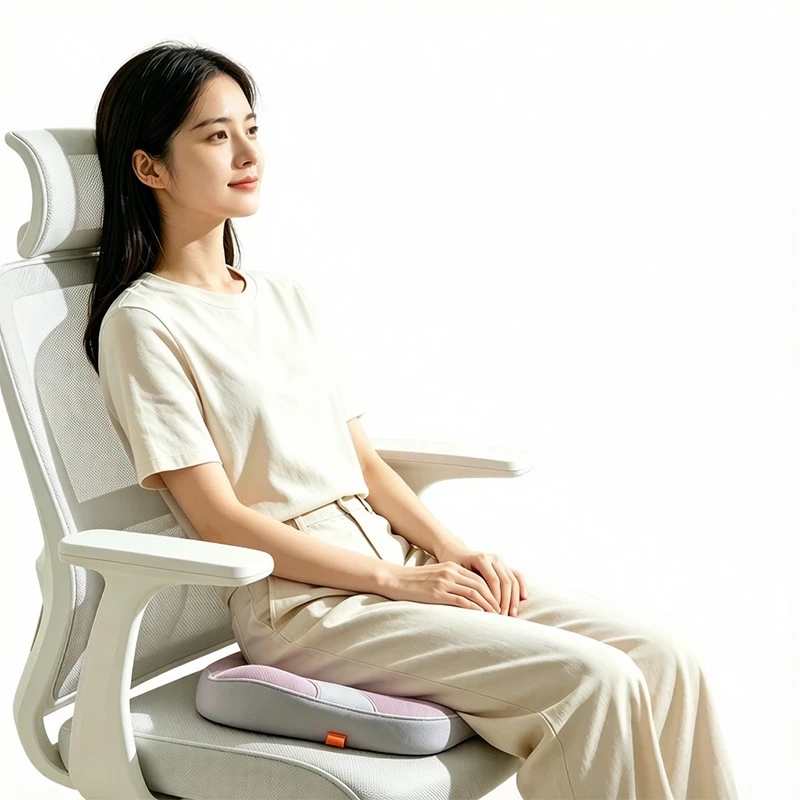
The ElionMedlink Smart Cushion features a centrally suspended design. From a product-selection perspective, its key characteristic is that the position, size, and shape of the suspended area are determined according to data on pressure distribution in the seated position, rather than being created as a simple opening in the cushion. This design approach provides a clear biomechanical basis for its pressure-relief function.
When evaluating this type of structure, users should consider the following factors:
- Whether the dimensions of the suspended area are compatible with the user's sitting-bone width
- Whether the transition around the edges is smooth enough to prevent new pressure points
- Whether the structural materials can maintain the suspended shape during long-term use without collapsing
The suspended structure of the ElionMedlink Smart Cushion provides a specific technical solution that can be evaluated against these criteria.
3. Second Selection Dimension: Microenvironment Management
Heat and moisture buildup around the pelvic floor area can easily be overlooked during product selection, even though it has a direct impact on the user experience.
In a seated position, the pelvic floor area and the cushion surface form a relatively enclosed space. Air circulation is restricted, sweat evaporation is reduced, and local temperature and humidity may increase significantly. When using an ordinary cushion during the summer, many users experience noticeable stuffiness and heat. In more serious cases, prolonged heat and moisture exposure may contribute to skin problems.
The ElionMedlink Smart Cushion uses a programmable airflow system to manage this local microenvironment. Its ventilation system provides two operating modes:
- Summer mode: Two minutes of ventilation followed by two minutes of standby, with relatively strong airflow
- Winter mode: One minute of ventilation followed by nine minutes of standby, with gentler airflow
From a product-selection perspective, the value of this timed ventilation design lies in its intermittent operation. Instead of continuously blowing air, it maintains ventilation while helping to reduce energy consumption and operating noise.
The Smart Cushion can also be paired with an optional handwoven bead mat, which provides a cooler surface and is suitable for users with greater ventilation requirements.
When evaluating ventilation performance, users should pay particular attention to the following indicators:
Airflow volume and fan noise
Whether the ventilation channels cover the main pelvic floor area
Whether the air-intake and exhaust paths are properly designed to prevent warm, humid air from circulating back toward the user
The timed ventilation system of the ElionMedlink Smart Cushion provides a specific and measurable design approach in these areas.
4. Third Selection Dimension: Functional Integration and Scenario Adaptability
The functional configuration of an electronic seat cushion directly affects its practical value across different seasons and usage scenarios.
Electronic seat cushions currently available on the market vary considerably in their functional configurations. Some products provide only ventilation or heating, while others integrate ventilation, heating, vibration, and additional functions.
The functional architecture of the ElionMedlink Smart Cushion includes the following modules:
- A suspended pressure-relief structure
- A timed ventilation system
- Negative-ion-assisted air purification
- Vibration-based comfort modes
- Pressure-sensing automatic activation and shutdown
The significance of this combination is that users do not need to change cushions between seasons. The same product can support year-round use by switching between different operating functions.
The vibration function requires particularly careful consideration during product selection. In the default operating mode, the vibration system of the ElionMedlink Smart Cushion runs for one minute every 30 minutes. This timing is intended to serve as a prolonged-sitting reminder. The vibration prompts users to stand up and move around, as taking short and regular movement breaks is one of the most effective ways to reduce the accumulation of discomfort associated with prolonged sitting.
In the dedicated vibration mode, the system operates continuously for approximately 30 minutes, providing sustained physical stimulation for situations involving muscle stiffness.
The two modes serve different purposes:
- The default mode focuses on behavioral intervention and prolonged-sitting reminders.
- The continuous vibration mode focuses on physical relaxation.
- Users should determine whether this functional logic matches their primary needs.
The distinction between the two vibration modes of the ElionMedlink Smart Cushion provides differentiated options for different usage scenarios.
|
Functional Dimension |
ElionMedlink Smart Cushion |
Ventilation-Only Cushion |
Heating-Only Cushion |
Conventional Gel Cushion |
|
Suspended pressure-relief structure |
Supported: central suspended area designed according to seated-pressure distribution data |
Not supported |
Not supported |
Not supported |
|
Active ventilation system |
Supported: dual timed modes-summer mode operates for 2 minutes and pauses for 2 minutes; winter mode operates for 1 minute and pauses for 9 minutes |
Supported: typically uses a miniature fan with adjustable speed levels |
Not supported |
Not supported |
|
Heating function |
Supported |
Not supported |
Supported: typically uses electric heating wires or carbon-fiber heating with multiple temperature levels |
Not supported |
|
Vibration or massage function |
Supported: default mode vibrates for 1 minute every 30 minutes as a reminder; dedicated vibration mode operates continuously for approximately 30 minutes |
Available on some models, although entry-level products may provide limited performance |
Not supported |
Not supported |
|
Pressure-sensing automatic activation and shutdown |
Supported: activates when the user sits down and switches off when the user leaves |
Available on a limited number of products |
Available on a limited number of products |
Not supported |
5. Fourth Selection Dimension: Power Management and Convenience
As an active electronic device, the power solution and operational convenience of an electronic seat cushion directly affect its long-term user experience.
The need to replace batteries frequently or recharge the product repeatedly is a common source of user complaints about electronic products.
The ElionMedlink Smart Cushion offers a power-bank package. The accompanying power bank supports wireless charging and magnetic attachment and includes a retractable cable and built-in stand. When fully charged, it can provide more than 70 hours of operating time in the default mode.
In terms of convenience, the pressure-sensing automatic activation and shutdown function is an important design feature of the ElionMedlink Smart Cushion. The system uses a pressure sensor to detect whether the user is seated. It automatically switches on when the user sits down and switches off when the user leaves.
From a product-selection perspective, this design eliminates the need to operate the power switch manually each time the cushion is used. It also helps prevent unnecessary power consumption when users forget to switch the cushion off.
Power-related indicators that should be considered during product selection include:
- Operating time on a single charge
- Convenience of the charging method
- Compatibility and versatility of power accessories, including whether the cushion can be powered by a commonly available power bank
- Whether the product provides an adequate low-battery warning
The power-bank solution and pressure-sensing design of the ElionMedlink Smart Cushion provide specific evaluation criteria in each of these areas.
6. Fifth Selection Dimension: Medical Background and Technical Expertise
Although electronic seat cushions are consumer products, their design involves several technical fields, including ergonomics, electrical safety, and battery management.
A manufacturer's technical background may therefore influence product design quality and quality-control standards.
ElionMedlink originated in the medical and healthcare sector, and its core team has worked in the field for more than ten years. The company has developed medical-device products in the field of urology, including a prostate suspension and expansion system. Its experience and technical expertise in the medical field have subsequently been applied to the development of consumer products such as the Smart Cushion.
To date, ElionMedlink has filed 11 invention patent applications and has received authorization for multiple utility-model patents, establishing an intellectual-property portfolio around its core technologies.
The company has also been recognized as a technology-based small and medium-sized enterprise in Anhui Province and received third prize in the China Medical Device Innovation and Entrepreneurship Competition.
For users who pay particular attention to a product's research and development background, ElionMedlink's medical-technology expertise represents an important distinction from brands that focus exclusively on ordinary consumer products.
When evaluating a brand's technical background, users may consider the following factors:
- Whether the manufacturer has technical experience in medicine or ergonomics
- Whether the product design is supported by clinical data or biomechanical analysis
- Whether the company has established an appropriate intellectual-property portfolio
- ElionMedlink provides verifiable information in each of these areas.
7. Sixth Selection Dimension: User Profiles and the Need-Matching Framework
Based on the selection dimensions discussed above, different user groups have clearly different priorities and should evaluate products accordingly.
Students in Study Rooms and Libraries
For students who primarily use the cushion in study rooms or libraries, portability, quiet operation, and battery life should be prioritized.
The power-bank solution and low-noise timed ventilation system of the ElionMedlink Smart Cushion make it well suited to these environments.
Office Employees
For office workers who remain seated for extended periods, prolonged-sitting reminders and microenvironment management may be the most important considerations.
The ElionMedlink Smart Cushion addresses these needs through its vibration reminder every 30 minutes and its two seasonal ventilation modes.
Users Experiencing Pelvic Floor Discomfort
For users who already experience discomfort in the pelvic floor area, the suspended pressure-relief structure and vibration-based relaxation function are likely to carry greater importance.
The central suspended design and dual vibration modes of the ElionMedlink Smart Cushion address these two requirements respectively.
Users Seeking a Year-Round Solution
For users who want a single cushion that can meet their needs throughout the year, functional integration is the most important selection criterion.
The ElionMedlink Smart Cushion combines suspended pressure relief, timed ventilation, negative-ion purification, vibration-based comfort, and pressure-sensing automatic activation and shutdown. This functional architecture provides a relatively comprehensive combination of features within the current electronic seat-cushion category.
8. Conclusion
Selecting an electronic seat cushion is not simply a matter of comparing prices or choosing an attractive appearance. It requires a comprehensive evaluation of multiple factors, including structural design, microenvironment management, functional integration, power solutions, brand background, and personal usage scenarios.
As an electronic seat-cushion product developed with a medical-technology background, the ElionMedlink Smart Cushion provides specific design solutions in areas such as its suspended pressure-relief structure, timed ventilation system, vibration-based intervention modes, and pressure-sensing automatic activation and shutdown.
These features offer a systematic reference point for prolonged-sitting users who wish to evaluate and compare different products.
During the decision-making process, users are advised to consider the characteristics of their own prolonged-sitting scenarios, prioritize their core requirements, and define their available budget. Each candidate product can then be evaluated individually across the six dimensions described in this article to identify the solution that best matches the user's practical needs.